Guide · 5 min read
What is AI governance in financial services, and why we need it now
Published
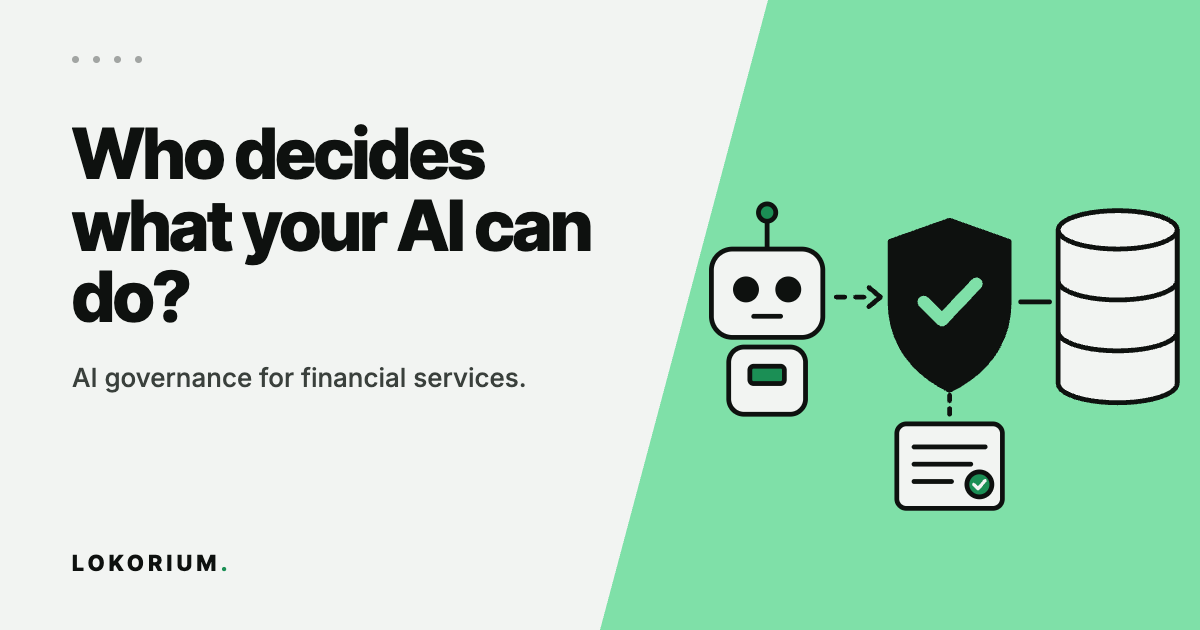
Most articles about AI in finance make the same promise: it will make you faster and cut your costs. That may well be true, but it isn’t what this one is about. This one is about safeguard and control. Once AI starts making decisions that touch customers and their money, someone has to set the limits, and someone has to be able to show what happened.
And chances are your firm already uses AI, even if nobody calls it that. A chatbot on the website. A tool that sorts the inbox. A model that flags odd payments. Back in 2024, three in four UK financial firms told the Bank of England and the FCA they were using AI, and another one in ten planned to (Bank of England, 2024).
So for most firms, the useful question is a different one. Who decides what the AI is allowed to do? And how would you know if it got something wrong? That, in short, is AI governance.
If you work at a small or mid sized financial firm, you probably don’t have a dedicated AI team yet. That’s normal. This guide explains the idea in plain words, why regulators care, and a few sensible ways to begin.
What AI governance means
AI governance is the set of rules, people and checks that decide how your firm uses AI. If that sounds abstract, think about how you treat a new member of staff. They get a job description, a manager, limits on what they can sign off, and a record of what they did. AI needs the same.
In practice it comes down to four parts.
Four parts keep AI use under your control
Rules
What AI may do and must never do
People
Who owns each AI tool and its results
Checks
Testing before use and checks while in use
Records
Proof of what AI did and why it was allowed
None of this has to be heavy. For a smaller firm it can start as a one page list of where AI is used, who looks after each tool, and what each one is allowed to touch.
When AI gets it wrong in finance
In most industries, a bad AI answer is embarrassing. In finance, it can mean someone is refused credit unfairly, a complaint is mishandled, or a vulnerable customer gets chased when they needed help. These are people’s money and lives, and the FCA expects firms to deliver good outcomes for them under the Consumer Duty.
There is a second reason. Many firms are using AI they don’t fully understand. In the same 2024 survey, almost half the firms using AI said they had only a partial understanding of the technology they were relying on (Bank of England, 2024). Often that’s because the AI comes from a supplier, built into software they bought.
Buying AI from someone else doesn’t hand over the responsibility. Your firm stays accountable for the result, even when a third party built the model.
What UK regulators expect
Here’s the bit that surprises people: there is no separate AI rulebook in UK finance. The FCA has said it won’t write new rules for AI. Instead, the rules you already follow apply to AI too (FCA).
What UK regulators expect from firms using AI
- FCA
- Good customer outcomes under the Consumer Duty, whether a person or a machine made the decision
- FCASenior managers rules (SM&CR)
- A named person is accountable for how AI is used. Handing a task to software does not reduce that responsibility
- Bank of England, FCA and HM Treasury
- Boards should understand the risks of the most advanced AI models, especially for cyber security
- Financial Ombudsman
- Clear expectations on record keeping, routes to a person, and disputes where no person is involved at all, such as a customer’s AI agent talking directly to a firm’s chatbot
- Data protection
- UK GDPR still applies whenever AI uses personal data
Sources are listed at the end of this article.
So the good news is you don’t need to learn a whole new set of rules. You need to show that the ones you know still hold when AI is involved.
Why AI agents raise the stakes
Most AI in use today gives answers. It drafts, summarises and suggests, and a person reads the result and decides what to do. AI agents work differently. They take actions themselves, like updating a record, sending a message or working through several systems to finish a task.
An AI agent acts without a person in between
AI assistant
- Request
- AI suggests
- Person decides
- Action
AI agent
- Request
- AI decides and acts
- Action
Nothing checks the agent’s step unless you build a check in.
In 2024, only 2% of AI uses in UK finance made decisions fully on their own (Bank of England, 2024). That number is set to grow quickly. The Financial Stability Board, which coordinates financial regulators worldwide, says firms should decide which actions an AI agent must never take, and which need a person’s approval first (FSB, 2026).
A bad answer can be spotted and ignored. A bad action has already happened by the time anyone notices.
Where a small to mid sized firm can start
Four steps will put you ahead of many firms your size.
List where you use AI. Include the AI built into tools you buy, like your CRM, chat software or collections platform. Most firms find more than they expected.
Give each one an owner. One named person who understands what it does and answers for it.
Write down the limits. What is each tool allowed to do, and what customer data can it see? Start with anything that touches customers or money.
Keep a record and look at it. If something goes wrong, can you show what the AI did and why? Pick a regular time to review it. Monthly is a good place to start.
How Lokorium helps
Steps three and four are where most firms get stuck. Writing rules down is one thing. Making sure every AI action actually follows them is another.
Lokorium is the final check before your data. You set the rules, and Lokorium checks each AI action against them before it happens. Every decision goes into a signed record that you hold and can verify yourself. So when a regulator, an auditor or the Ombudsman asks what your AI did, you have the answer. It helps you show compliance, one decision at a time.
Sources
- Artificial intelligence in UK financial services 2024, Bank of England and FCA
- AI and the FCA: our approach, FCA
- Joint statement on frontier AI models and cyber resilience, Bank of England, FCA and HM Treasury, 15 May 2026
- Response to the FCA review into the long term impact of AI, Financial Ombudsman Service, 2026
- AI and the UK Financial Conduct Authority, WilmerHale, April 2026
- AI regulation in financial services: turning principles into practice, BCLP, December 2025
- Busy week for AI: FCA reopens AI Input Zone, Cooley, May 2026
- FCA AI approach: what the AI Lab offers firms, Bratby Law
- FSB consults on sound practices for the responsible adoption of AI, Financial Stability Board, June 2026